

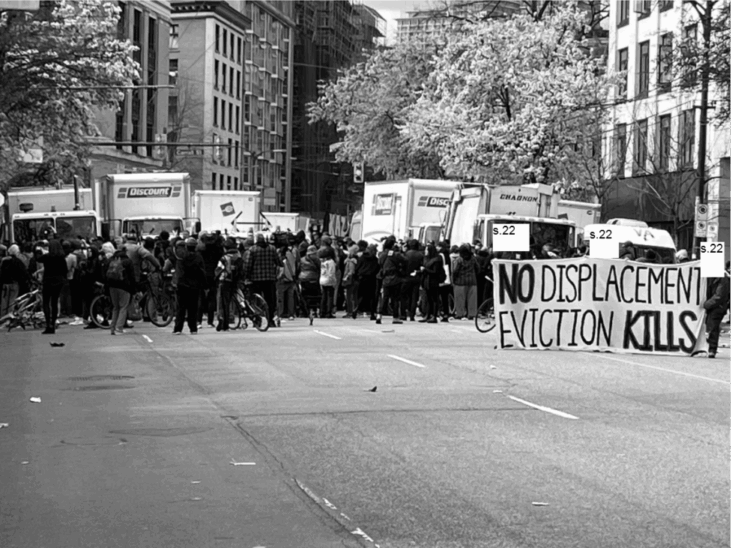
Uncredited photo from a BC government freedom of information document. April 5, 2023. Vancouver, BC.
On the evening of April 5, 2023, as the first day of the Hastings decampment operation came to a close, Vancouver Mayor Ken Sim sent out a carefully worded press release.
“8 people living in the East Hastings encampment have requested shelter and have been accommodated,” according to Sim’s release.
But internal correspondence shows that no branch of government was able to track who actually stayed at a shelter they were allegedly offered that night.
In an email to The Mainlander, the City confirms that at the time of decampment it “could not determine whether East Hastings encampment referrals stayed at the shelter on a particular night.” The Mainlander reached out to BC Housing, who deferred to the City.
The reality is that Sim could only truthfully say that eight people were verbally offered shelter – or simply told to line up at one of the City’s shelters while being hurriedly forced to pack up – and not whether any of these individuals actually received a shelter space.
A month prior to decampment, a coordinator for Carnegie Outreach – a City of Vancouver social service – noted the inability for provincial and municipal governments to track who ended up in the shelters they were referred to.
In an email to BC Housing staff, the coordinator said, “we cannot verify that these folks attended to or stayed at the referred to shelter,” as the shelter facilities were not all using the same tracking database as Carnegie Outreach and BC Housing.
The Mainlander obtained hundreds of pages of correspondence between BC Housing, the City of Vancouver and a number of nonprofit housing organizations, including PHS Community Services Society, through freedom of information requests.
Harmful BC Housing freezes continue
While the documents poke holes in Sim’s messaging, they also reveal that BC Housing coordinated to ensure that housing units and shelter beds were empty for the week of the Hastings decampment, at a time when thousands of people were enduring homelessness in the city.
Correspondence shows that one nonprofit held more than 100 housing and shelter units empty for the week of April 3 to 7, 2023, the same week as the Hastings decampment.
Some of these housing units potentially sat empty for lengthy periods during a housing crisis in order to make space for the people who were slated for decampment, in theory.
But neither the City nor BC housing are able to confirm that a single person displaced as part of the Hastings decampment successfully secured housing that day.
The internal correspondence confirms a concern that many residents, including legal organizations and late community leader Chrissy Brett, have voiced for years: BC Housing keeps existing housing units and shelter beds empty for planned mass displacements.
Two days prior to the Hastings decampment in 2023, a BC Housing staff member stated in an email to colleagues that PHS had committed to making 117 shelter and housing units “available” for the same week as the Hastings decampment.
But PHS claims they were given no warning about the decampment.
In an email to The Mainlander, PHS says they “had no involvement with government to prepare for the Hastings Street sweeps (or even notice).”
When shown an email from the day prior to the decampment from a PHS director to BC Housing that discussed units “for the Hastings encampments,” PHS responded that the units held for the same week as the decampment were part of a different BC Housing-led initiative to expedite housing units.
Nonprofit housing directors at Atira and First United made similar claims to the Vancouver Sun during the decampment of Oppenheimer Park in 2019. They alleged that while BC Housing coordinates “housing freezes” through the supportive housing nonprofits they contract out to, those nonprofits are made unaware of the reasons for a housing freeze.
In an email, BC Housing confirmed to The Mainlander that some single occupancy (“SRO”) units were held for people living in Vancouver encampments, but did not specify a number of units or length of time. BC Housing clarified that these were existing units, not new housing units waiting to be tenanted.
“Given the urgent need to bring people indoors after the decision to close the encampment, the Province prioritized people from this encampment to the available indoor spaces,” BC Housing added.
Housing freezes can create “a bottleneck for anyone who needs emergency housing,” noted Carnegie Community Action Project and Pivot Legal Society in 2019.
In the case of the April 5, 2023 Hastings decampment, supportive housing units were withheld from people on BC housing waitlists unless they were being displaced directly from an encampment.
During the period these units were held, people who were unsheltered outside of encampments, or requesting transfers for their safety, were inevitably excluded from these units.
At the same time, total affordable housing units were declining in the city.
Public health impacts
The blocking off of Hastings meant that people in Vancouver had less access to public space than before the decampment, which may have pushed people living outdoors into more isolated areas.
A few days after the Hastings decampment, Vancouver Coastal Health provided their “brief summary of the decampment” to the BC government.
According to VCH’s summary, “[a]pproximately 40 people that were regularly outreached on Hastings, could not be located” the next day. (116 VCH workers signed a letter condemning the Hastings decampment; VCH itself, however, did not).
In a press release from the BC Civil Liberties Association, a plaintiff in a legal challenge to the city’s daytime outdoor sheltering ban, Jason describes his experiences of displacement: “Imagine someone coming into your house, attacking you, taking your stuff, then destroying your house, and saying ‘have a nice day.’ That’s how it feels.”
Another plaintiff, Zee, says, “Imagine just being alive and everywhere you go, every moment of the day, you are getting a very clear message that there’s no space you can exist in.”
Previous reporting by The Tyee estimated that police and City worker expenses for the Hastings decampment were at least $548,000 for the week.
Those costs do not include the resources from BC Housing, nonprofit housing providers, and other government branches that are poured into broadly coordinated displacements.
Documents show that BC’s Ministry of Social Development and Poverty Reduction was aware of a “final enforcement phase” on March 27, 2023 or earlier. A presentation leaked days prior showed that the City had formulated a multi-stage plan for the Hastings decampment.
The City also facilitated multiple smaller scale decampments in the months leading up to April – including on February 22, 2023 when more than a dozen Vancouver police officers descended onto a single block of Hastings to displace people.
Inhumane housing system
Documents show that one BC Housing employee requested a personalized street sweep outside their Gore Street office to the City’s then-director of homelessness services, Sue Baker.
The BC Housing employee was working at the organization’s only Downtown Eastside office, Orange Hall, and felt people living outside were “beginning to obstruct” the pathway.
On Jan. 10, 2023 the employee asked, “Would it be possible for engineering to connect with these folks about downsizing?”
Twenty minutes later, Baker responded, “Yes I will follow up with engineering.”
“We don’t understand what [The Mainlander means] by “an individual request for a street sweep,”” writes the City.
The City says it was, “a request that the City work with those sheltering in front of Orange Hall to comply with the Street and Traffic By-law to take down their structures and reduce their footprint.” The BC Housing office was closed to the public at the time.
“Imagine someone coming into your house, attacking you, taking your stuff, then destroying your house, and saying ‘have a nice day.’ That’s how it feels.”
The City confirmed that Baker is still an employee, but would not be available for an interview.

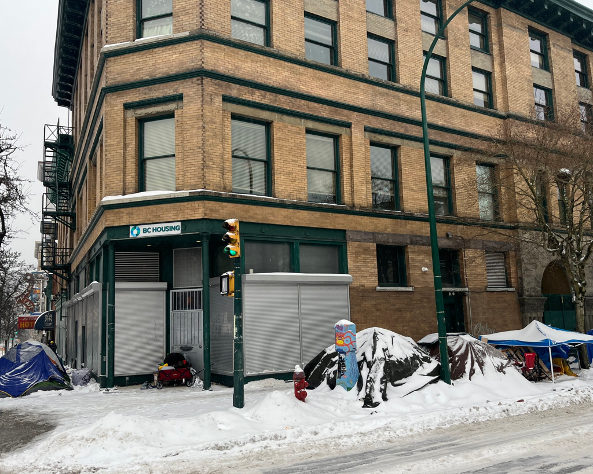
BC Housing’s Orange Hall, the only BC Housing Downtown Eastside location. December 24, 2022. Photo by Tyson Singh Kelsall.
Despite redactions and the fact that many decisions were made during virtual meetings with no paper trail, these documents provide insight into the province's decampment process. They offer important details about the government, nonprofit machinery, and individuals who, as part of their employment, coordinate mass displacement events, daily street sweeps, and the ‘supportive’ housing system.
As Sim put out his evening press release, tents had re-appeared along Hastings Street. People were scattered across their neighbourhood and beyond, and those with healthcare teams were difficult to locate in the following days. Meanwhile the daily cycles of displacement continued.
The documents obtained via freedom of information are available in full below.
Consider sustaining The Mainlander.