
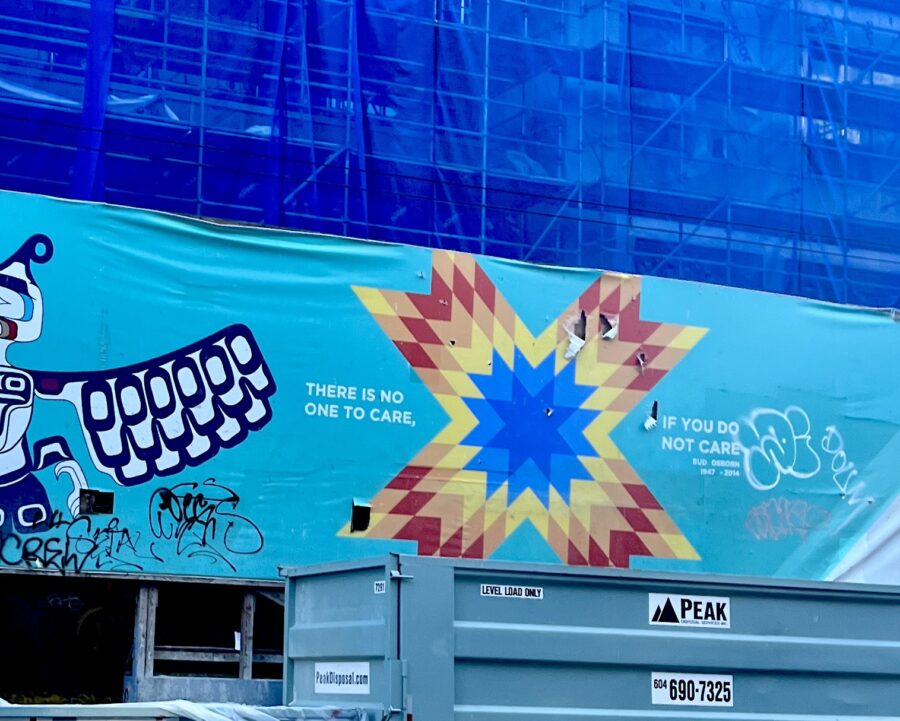






At the divide of the Downtown Eastside and the rest of the cityscape sits the Woodward's development.
Arrive on any random morning and walk a few blocks east – park rangers will be displacing people from Oppenheimer Park. Walk south of Oppenheimer and you will see sanitation workers and armed police officers forcing people off the sidewalk, throwing personal possessions into a garbage truck. Sometimes these are the last objects a person has safeguarded after being evicted, including sentimental items, such as family photographs and loved ones’ ashes.
Fewer people have adequate or dignified housing, and the use of public space has become increasingly criminalized.
The criminalization of survival continues to churn in the DTES. Shelters are full each night, almost every community health centre has a waitlist, detox has become exceedingly complex and dangerous due to the shifting toxic drug supply, and spaces that provide respite from gendered violence have been defunded and shuttered. Vital services are also dwindling – the neighbourhood lost its only two post offices in the past year.
In recent months, police officers have been showing up multiple times each day at Main and Hastings to shake people down, as people try to make enough cash to survive as street vendors. Meanwhile, the province’s social assistance rates remain far too low to survive on.
Housing is being closed down without replacement. Three social assistance rate single room occupancy buildings on the Granville strip will be closed in time for the FIFA 2026 soccer games. The levels of government forcing this eviction – provincial and municipal operating in tandem – have built zero units of housing to replace these, neither temporary nor permanent. Mayor Ken Sim has proposed five hypothetical sites for alternative housing while simultaneously passing a Vancouver-wide supportive housing freeze. Social assistance rate units have already been on a net decline for at least the past decade.
There is nowhere to go.
It was not a surprise when London Drugs left Woodward’s in February, but rather the finale of a prolonged panic-fueled campaign against the DTES community for more property tax breaks from city hall.
Of course, there was less moral outrage in the headlines about the busy London Drugs that closed in Renfrew-Collingwood, just one day after the retail chain closed its Woodward’s location.
In 2023, JJ Bean announced they would be leaving their location in the Woodward’s building. On their way out, they similarly whipped up anti-poor resentment through sensational media appearances. This was by no means a new angle for the coffee chain. JJ Bean founder John Neate has routinely punched down, using his platform and resources to lobby for expanded policing and drive a successful union-busting campaign in 2011.
When London Drugs closed, just as the JJ Bean did three years prior, the question to ask is not “what went wrong?” but rather, how were these hypercapitalist enterprises ushered into this space in the first place?

Clipping from the Vancouver Sun. June 4, 2003.
It is fitting that before the London Drugs space was even emptied, the Vancouver Police Department, buoyed by their Mayor Ken Sim, began their own public relations campaign to turn the emptied storefront into a police training facility. The VPD training ground is expected to come with a full property tax break for the building’s private owner, currently valued at a loss of roughly $170,000 per year to City revenue, according to CTV News.
This campaign picked up where London Drugs and JJ Bean left off, and reflected both a wave of endless police expansion under a cop-endorsed council, as well as the loss of a fraught vision for Woodward’s that included community building and inclusion.
The VPD has already established an annex in Woodward’s to headquarter its “District 5” initiative – a new unit within the VPD that only polices the DTES. And just months prior to that, a community policing station took the place of the former TD bank branch at Woodward's.
But London Drugs, nor the dimming visions for the Woodward’s building need to be lost to a training ground for more policing and criminalization in the community.
There are alternatives.
There are residents ready to distribute a locally manufactured, regulated drug supply through a community-run pharmacy, which in a former London Drugs would come pre-constructed. There remains a need for a peer-run, culturally competent sobering/withdrawal space. Supervised consumption sites have been closed down and lost, despite needing to be scaled up during an ongoing toxic drug crisis.
Community members have also been working to establish a DTES-led research ethics board to have some control over the endless studies and temporary pilot projects done in the neighbourhood. Disinformation has filled a void as accessible media has declined, and a robust neighbourhood media organization could address this gap.
With the departure of London Drugs, the DTES lost its remaining post office which now needs replacing. Community members and healthcare workers together have also called for increased access to low-barrier wound care as the drug supply complicates wounds, while there's been a long-standing need for more public washrooms. When you add the community spaces of the "peoples' vision for Woodward's" following the 2002 Woodsquat – libraries, pottery and carpentry workshops, communal kitchens – today's empty space at Woodward’s is large and central enough for everything.
