





i.
The first time I reversed an overdose my hand shook as I held the needle. A strange disconnect to observe because I felt calm and confident. Still, when this memory – nearly a decade old now – comes into focus, I see life and death swirling; their collective pressures meet at the centre of my memory’s frame, my hand trembles.
R* snapped awake as I emptied the syringe into his left arm and the needle retracted – this was before the sedatives. I wish I could say that we served R* a cold glass of water, placed his hat on the side-table as he caught his breath and the golden hour sun draped through the window onto his favourite chair. In reality, R* firmed his grip on the shelter’s washroom counter, pushed his hands down a little to shift his weight, and stared into the mirror under painfully bright fluorescence. I stood with him for a moment before I walked back to the physician’s office-turned-supervised use site where I was on shift.
ii.
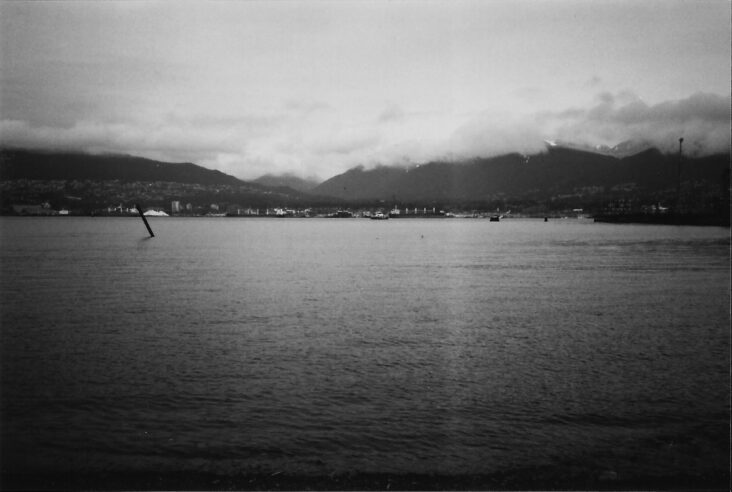
Visiting CRAB park back then, at the edge of Vancouver’s Downtown Eastside, I would intuitively stare off in all four directions. Take note of how the park’s beach divides the city. Port and industry to the east. Ocean inlet — source of salt water air — and mountain ridges to the north. DTES bordering the southeast, while the financial district looms from behind and wraps around west.
These days when I walk across the overpass and sit at a park bench, I see floating traces of friends and family, clients and acquaintances met in brief. I see ghosts stumbling on the shoreline.
In the glass towers behind CRAB park, the offices are bland and disconnected. Their expense is too great to hold any life. To the lifeblood of the city, moving like ants if you were to look down from floor 14 or 23, the towers are parasitic – the churn of financialization and criminalization of everyday life moving in tow. A new story added with every overdose death or death by exclusion.
Toxic drugs – an aggregate of toxic drug war policy, toxic economics, and toxic colonial public health priorities – kill directly by poisoning and overdose. The sanctioning of an unpredictable and shifting drug supply by the state, spirited onward by police and others who benefit from the status quo drug trade, kills five people per day in British Columbia. Through infections, prolonged sedation, the risks of unregulated, experimental treatment programs, impacts on wounds and bodies – the drug supply contributes to premature death in unfathomable ways. The state just shrugs its shoulders or worse, cannot even be bothered to acknowledge the mass death and disabling crisis it has created and enables.
When T* falls forward into my arms at his place near the Georgia Viaduct after a small ‘test’ dose, I call for support and others take over – hospital records will show he wakes up 15 hours later tired in his bones. This is after the sedatives cascade into the supply.
I flew one province over when A* was in a coma, body overwhelmed by its own response to an infection as the needles and pipes were put back in hiding. I asked the healthcare staff, what happened? The paramedics de-prioritized your family because her pain seemed less urgent despite the documented screams. Overdoses were happening everywhere. Let us show you the statistics.
iii.
When I get my hands on something solid, I crush it up first. Gather a straw cut in half with scissors. When able, increasingly rare, I prefer the milk of paradise to its synthetic sibling, though I will be more nauseous later (next time switch to smoke and glass). Let out a soft hmm as the drip in the back of the throat comes at last, something I await but not everyone cares for.
I feel my blood flow like warm gold. Sit back softly for the first time in days, a week, maybe months. The static is silenced, and even grieving without the infinite rage and rationalization is possible. All grief is ritual, this is just one form.
I am no one in particular – we all live with the emergency, though its brutality is burdened unevenly.
The lifeblood is slowly drying. Listen for a moment at the way sound travels through the emptied back alley, and you can hear a city being hollowed out. As the decade passes, it is hard to know how many hours to spend each day calling out for help, and what to take in your own hands, whether trembling or finally still now.
Note from The Mainlander: A public gathering will be held tonight – April 14 – at Oppenheimer Park beginning at 5:30 PM, with a vigil to start at 7:00 PM. The event is organized by the Coalition of Peers Dismantling the Drug War, Surrey Union of Drug Users, P.O.W.E.R., Vancouver Area Network of Drug Users, with support from other members of the community, to mark 10 years since the province declared deaths from the toxic drug crisis a formal public health emergency.
